Budget
25 Gifts Under $50 That Look Far More Expensive
Written by The Gift Tool Editorial Team. We test our tools, read the research, and update this piece when our thinking changes. The Gift Tool is an Amazon Associate; we earn a small commission on qualifying purchases, but our picks are never pay-to-play.
There's a category of gift that costs $35 and reads as though it cost $150, and another that costs $80 and reads as though someone grabbed it from a servo. The difference has almost nothing to do with price and almost everything to do with four things you can control.
Once you know the four rules, the list of what to buy becomes obvious. So let's do the rules first.
The four rules
1. Narrow beats broad
A gift set with twelve items in it reads as cheap regardless of what it cost, because variety signals that the giver didn't know which one you'd want. One excellent thing reads as considered.
A single 500ml bottle of very good olive oil looks more expensive than a hamper containing olive oil, crackers, dip, jam, a tea towel and a small jar of something unidentifiable — even when the hamper cost more.
2. Materials read instantly
People assess value in under a second, and they do it on material rather than price. Solid wood, brass, glass, ceramic, wool, leather and heavy paper all read as expensive. Thin plastic, printed synthetic fabric and shiny chrome-effect finishes read as cheap, even at high prices.
At $50, you can buy a genuinely nice object in a good material or a mediocre object in a bad one. The first always wins.
3. Brands people don't buy for themselves
The gap between "what I'd buy for myself" and "what I'd like to own" is where good gifts live. Hand cream is the classic example: almost nobody buys themselves the $40 hand cream, and almost everybody enjoys owning it.
Look for the tier just above what your recipient would ordinarily choose.
4. Presentation is 30% of the perceived value
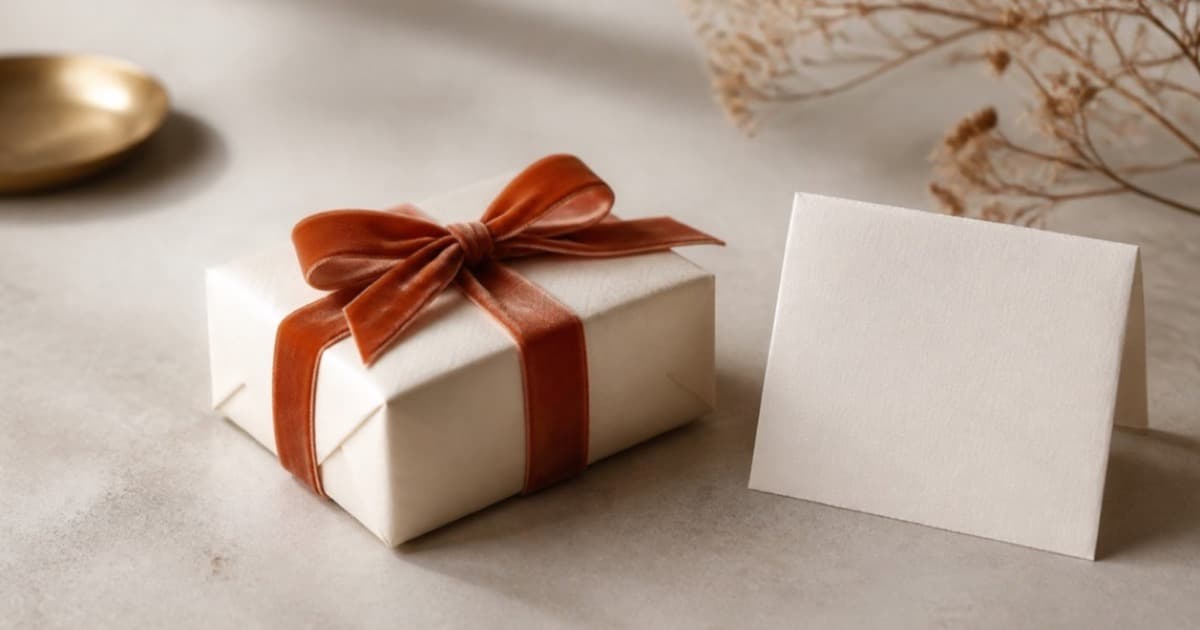
Two identical gifts, one in the shop's plastic bag and one in heavy kraft paper with a fabric ribbon and a handwritten card, are not perceived as the same gift. This isn't a trick — it's a genuine signal about how much care went in. More on this in How to Personalise a Gift You've Already Bought.
One good thing, wrapped properly, beats a box of many things. Photo via Unsplash.
The 25
Food and drink ($15–$50)
- Single-origin coffee from a local roaster. Ask for something roasted in the last two weeks and have them grind it for the recipient's method. Around $25.
- A serious olive oil. Single-estate, harvest date on the bottle, in a tin or dark glass. $30–$45.
- Aged balsamic. A small bottle of the real thing is one of the most consistently over-delivering gifts in the category. $35.
- Proper chocolate. Three bars from a bean-to-bar maker beats any boxed assortment. $30.
- Chilli oil or a hot sauce flight from a small producer. $20–$35.
- A jar of raw honeycomb. Looks extraordinary, costs about $20.
- Loose-leaf tea in a decent tin. Skip the flavoured supermarket tier entirely. $25–$40.
Home ($20–$50)
- A hand-thrown ceramic mug from a real potter. Two to three times the perceived value of a printed mug at a similar price.
- Linen tea towels. Genuinely nice ones, in a plain colour. $30 a pair.
- A brass or solid-wood bottle opener. Weight in the hand does all the work. $25.
- A small candle from an actual chandler, not a mall brand. Soy or beeswax, wooden wick. $35–$45.
- A wool throw or blanket, if you can find one on sale. Materials rule in full effect.
- A good chopping board in end-grain timber, small size. $45.
Personal ($15–$50)
- Merino or cashmere-blend socks. Plain, dark, thick. Nobody buys these for themselves and everybody wears them out. $25–$35.
- The good hand cream. The $40 one. $40.
- A silk pillowcase or eye mask. Reads luxurious, costs $35–$50.
- A very good pen. A brass or matte-black fine-liner with a refill cartridge. $30.
- Leather cardholder or key fob. Full-grain, not "genuine leather" (which is the lowest grade despite the name). $45.
Interest-led ($15–$50)
- A hardback in their exact niche. Not a bestseller — the specific one about the specific thing they're into. $35–$45.
- Seed packets and a propagation station for a plant person. $30.
- Bitters and a bar spoon for someone who makes cocktails. $40.
- A single specialty ingredient for a cook — saffron, vanilla beans, a good miso, dried porcini. $25–$45.
- A three-month magazine or newspaper subscription in a field they care about. $40.
- A city-specific print or map of somewhere meaningful to them, unframed. $35.
- A day pass or single class — pottery, climbing, printmaking, a knife skills workshop. $45–$50 and it becomes a memory rather than an object. Our guide to matching gifts to occasions explains why that fit matters.
The pairing trick
If a single item at $30 feels thin, pair it rather than upgrading it. Two related things at $20 and $15 read as a curated set:
- Coffee beans + a small ceramic cup
- A novel + a proper bookmark
- Olive oil + flaky sea salt
- Socks + a bar of good chocolate
- Seeds + a pair of decent secateurs
The connection between the two items is what makes it look intentional. Random pairs read as padding; related pairs read as a theme.
What to avoid at this price point
- Anything electronic. Under $50, you're buying the compromised version of something. Cheap earbuds, cheap smart devices and cheap chargers all fail within a year and reflect badly on the giver.
- Multi-item gift sets from supermarket seasonal aisles.
- Anything with "gift set" printed on the packaging.
- Novelty items with a joke on them.
- Branded merchandise unless they're an actual fan of the thing.
- Jewellery, unless you know their taste exactly. It's the single hardest category to get right at any price.
Making $50 look like $150 in practice
A worked example. You have $45 and you're buying for your partner's mother, who cooks a lot.
The weak version: a $45 boxed set of assorted kitchen gadgets. Six items, plastic packaging, half will go in a drawer.
The strong version: a $28 bottle of single-estate olive oil with the harvest date on it, a $9 box of flaky sea salt, and a $6 kraft box with a fabric ribbon. Handwritten tag: "For the roast potatoes. You've been carrying that dinner for a decade."
Same money. Completely different gift. The second one is specific, high-material, well-presented and narrow — all four rules — and it will be discussed at the table, which the boxed set never will.
If you want a second opinion before you buy, the Gift Checker will score anything you're considering against fit, timing and signal in a few seconds.
FAQ
What's the best gift under $50? Excellent consumables — single-origin coffee, real olive oil, bean-to-bar chocolate — because they deliver a high-quality experience without creating storage burden, and quality is immediately obvious.
Do cheap gifts look cheap? Only if they're broad, poorly made or badly presented. A narrow, well-made, well-wrapped $30 gift consistently outperforms an $80 gift set. Research on gift-giving shows recipients don't link price to appreciation the way givers assume they do.
How do I make a gift look more expensive? Buy one thing rather than several, choose natural materials over plastic, pick a brand a tier above what they'd buy themselves, and wrap it properly with a handwritten note.
Are gift cards a bad idea under $50? They score well on choice but near-zero on thoughtfulness. If you use one, pair it with one small specific object so there's something to open.
What's a good gift under $50 for someone I don't know well? Very good food or drink. It works across almost every demographic, needs no personal knowledge, and creates no obligation to keep anything.
Keep reading: How Much to Spend on a Gift · How to Find Cheap Christmas Gift Ideas That Look Expensive · How to Personalise a Gift You've Already Bought
Working to a number? The AI gift generator takes your budget and one line about the person and returns 20 ideas that fit both.
Still stuck on the perfect present? The AI gift generator turns a one-sentence description into 20 personalized ideas in about a minute.