Choosing well
How to Use AI for Gift Ideas That Actually Feel Personal
You open an AI gift finder and type: “Gift ideas for my boyfriend.”
It gives you a wallet, a watch, a Bluetooth speaker and a set of whiskey glasses. Nothing is technically wrong. Nothing feels like him, either.
That is the central problem with using AI for gift ideas: the tool only knows the person you describe. If you give it a relationship, an age and a budget, it can only return the average gift for someone in that category. The way out is not a longer product list. It is a better description of one real person.
The quick answer
To use AI for gift ideas, tell it what the recipient has asked for, what they actually do each week, what they already own, what they dislike, the occasion and your firm budget. Ask for a short list with a reason for every suggestion. Then check the best three ideas for usefulness, effort and personal fit before buying anything.
Already have a product in mind? Skip the brainstorming and put it through the Gift Checker instead.
A copy-and-paste AI gift prompt
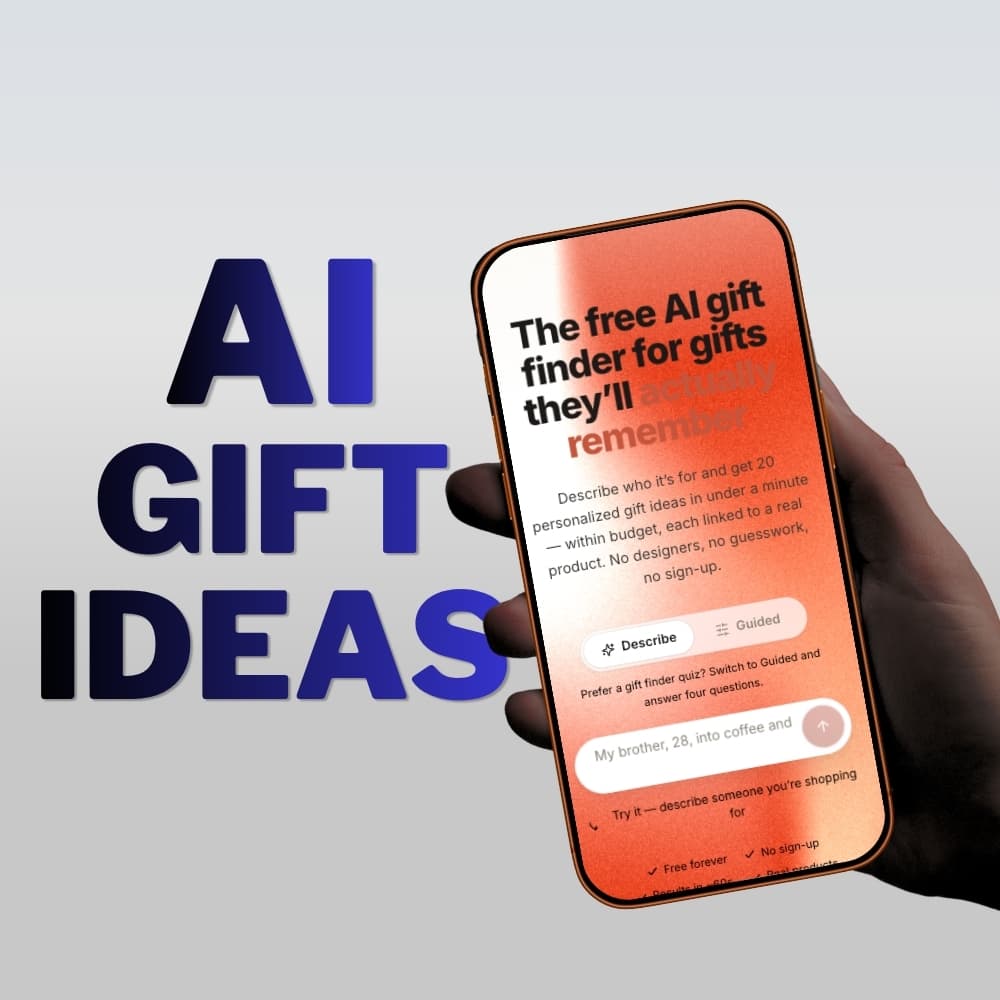
Use this prompt when you want ideas from a general AI assistant, or enter the same details into The Gift Tool’s free AI gift finder:
I need a gift for my [relationship] for [occasion]. My budget is [amount] and I do not want suggestions above it.
They are [age or life stage] and spend their free time [real activities]. They recently mentioned [something wanted, needed or complained about]. They already own [relevant items]. They like [specific tastes, brands, places or interests] and dislike [clutter, certain styles, foods, joke gifts, difficult setup, etc.].
Our relationship is [new, close, long-distance, professional, etc.]. The gift should feel [useful, sentimental, fun, low-pressure, celebratory, etc.].
Give me 10 specific ideas. For each one, explain what detail above makes it a fit, what I should check before buying, and one way to make it more personal. Include a mix of physical gifts and experiences. Do not repeat generic ideas unless you can make them specific to this person.
The final sentence matters. You are not asking AI to fill a page. You are asking it to defend each suggestion against the evidence you supplied.
Why generic prompts produce generic gifts
“A gift for a 30-year-old man” sounds specific, but it describes millions of people. It tells the AI nothing about whether this man spends Saturday morning trail running, restoring an old car, taking his daughter to swimming lessons or sleeping after a night shift.
Age, gender and relationship are useful boundaries. They are not a personality.
The best clues tend to be ordinary:
- what the person repeatedly does;
- what they have mentioned more than once;
- what is worn out, missing or mildly annoying in their life;
- what they would enjoy but rarely buy for themselves;
- what they already have too much of;
- what would create work, clutter or embarrassment for them.
These details move the task from “name popular gifts” to “solve for this person.” Gift-giving research helps us decide which details matter most.
1. Tell the AI what they have actually asked for
Many people avoid requested gifts because they feel too obvious. They want the present to prove that they know the recipient well enough to invent a better answer.
The evidence points the other way. Across five studies, Francesca Gino and Francis Flynn found that recipients were more appreciative of gifts they had explicitly requested. Givers, however, expected requested and unrequested gifts to be appreciated similarly because they believed the surprise would seem more thoughtful (Gino & Flynn, 2011).
So if the person sent a link, named a brand, mentioned a book or keeps borrowing the same item, put that near the top of the prompt. Do not bury your strongest evidence beneath a paragraph of personality adjectives.
A request does not remove thought from the gift. You can choose the right version, add a note or pair it with something small. If you want to make asking easier before the next birthday, The Gift Tool’s birthday wishlist maker lets someone share exact ideas without an awkward group-chat interrogation.
2. Describe their real life, not their ideal self
Gift givers are drawn to desirable gifts: the beautiful coffee machine, the ambitious hobby kit, the impressive weekend away. Recipients have to live with the practical details.
Research by Ernest Baskin and colleagues found that givers placed more weight on desirability, while recipients placed more weight on feasibility—the ease and convenience of actually using the gift (Baskin et al., 2014).
That finding changes the information you should give AI. Do not write only, “She loves cooking.” Add:
- she has a small kitchen;
- she already owns a mixer;
- she cooks on weeknights but not weekends;
- she dislikes single-purpose gadgets;
- she has no room for another appliance.
Now the AI can look for a gift that fits her kitchen, not a fantasy kitchen from a product catalogue.
This is especially important for subscriptions, plants, pets, large homewares, technical hobbies and anything that needs assembly or ongoing payments. A gift stops feeling generous when it quietly hands the recipient a new job.
3. Ask for satisfaction, not the biggest reaction
There are really two moments in a gift’s life: the ten seconds when it is opened and the months after that.
Gift givers can become overly focused on the first. Adelle Yang and Oleg Urminsky found that givers sometimes chose gifts expected to create a stronger immediate reaction even when another option was expected to produce greater overall recipient satisfaction. The tendency weakened when givers did not expect to see the gift opened in person (Yang & Urminsky, 2018).
You can counter that bias in an AI prompt:
Prioritize what they will still enjoy or use after a month, not what will create the biggest reaction when opened.
This steers the list away from oversized novelty gifts and toward ideas that survive contact with daily life. If an idea looks exciting but you are unsure whether it will last, use the five-factor guide to checking whether a gift is actually good.
4. Ask for experiences when your goal is connection
Physical gifts are not automatically shallow, and experiences are not automatically meaningful. But if your main goal is to feel closer, an experience deserves a place on the shortlist.
Cindy Chan and Cassie Mogilner found that experiential gifts strengthened relationships more than material gifts in the situations they studied. The effect did not depend on the giver sharing the experience. It was linked to the stronger emotion recipients felt while consuming the experience (Chan & Mogilner, 2017).
“Experience” does not have to mean flights or an expensive concert. It could be a class connected to an existing interest, tickets to a local event, a planned day together or a booking that removes the usual effort from the recipient.
Give AI the constraints that make the experience usable: location, dates, transport, accessibility, childcare, preferred crowd size and whether the recipient likes surprises. The research supports experiences as a category; it does not make an inconvenient experience a good gift.
5. Let the AI consider sentimental ideas
Sentimental gifts are difficult because they expose the giver. A photo, letter, restored object or reference to a shared memory can feel more vulnerable than buying a polished product from a familiar brand.
That discomfort can make givers play too safe. Julian Givi and Jeff Galak found that givers’ fear of choosing the wrong sentimental gift led them away from options that recipients could prefer (Givi & Galak, 2017).
AI cannot know which memories matter unless you supply them. Try adding:
Include two sentimental ideas connected to [shared trip, family story, achievement, running joke or tradition]. Keep them sincere and understated, not heavily customized.
The word “understated” is useful when you want personal without turning someone’s face, name or private joke into a large decorative object. If you have already bought something ordinary, you can still add meaning with the ideas in How to Personalise a Gift You’ve Already Bought.
6. Give a piece of yourself—but make the bridge clear
“Buy for them, not for yourself” remains a good warning. Yet a gift can reflect the giver without being self-centred.
In six studies, Lara Aknin and Lauren Human found a consistent preference for gifts reflecting the recipient’s interests. At the same time, gifts that reflected the giver produced greater reported closeness in the contexts they examined (Aknin & Human, 2015).
The useful distinction is between sharing and imposing.
- Sharing: “This is the cookbook that taught me to make the meal you liked. I marked three recipes for us.”
- Imposing: “I love advanced French cooking, so I bought you a complicated French cookbook even though you rarely cook.”
Tell AI something you genuinely want to share—a book, place, recipe, hobby, film or tradition—then ask it to connect that thing to the recipient’s tastes. The connection is the gift. Without it, you may simply be shopping for yourself.
7. Set a firm budget before generating ideas
Do not ask for ideas first and decide what is affordable later. A firm ceiling prevents the shortlist from anchoring you to gifts you never intended to buy.
It also reflects what recipients report. Francis Flynn and Gabrielle Adams found that givers expected more expensive gifts to produce more appreciation, while recipients in their studies did not report the same relationship between price and appreciation (Flynn & Adams, 2009).
Give AI one total figure and say whether it includes delivery, tickets, accessories or a meal. Ask it not to exceed the number. If you are buying for a partner and unsure where to set that ceiling, start with the site’s guide to how much to spend on a boyfriend’s gift, then adjust for your own finances and relationship.
A better five-step AI gift workflow
Step 1: Gather three pieces of evidence
Before opening the tool, write down:
- one thing the person asked for or mentioned;
- one thing they do regularly;
- one constraint that could make a gift inconvenient.
If you cannot answer any of the three, ask them or someone close to them. More browsing will not repair missing knowledge.
Step 2: Generate a deliberately mixed shortlist
Use the full prompt above and request:
- four practical or requested ideas;
- two experiences;
- two sentimental ideas;
- two wildcard ideas that still match the evidence.
This produces variety without asking for random novelty.
Step 3: Remove any idea the AI cannot justify
Read the explanation before the product name. If the reason is simply “many people enjoy this” or “this is a popular gift,” remove it. A worthwhile suggestion should point back to a detail about the recipient.
Step 4: Check the final three
For each remaining idea, ask:
- Did they request it or leave a clear clue?
- Can they use it easily in their real life?
- Does it fit this relationship and occasion?
- Is it comfortably within budget?
- Can I explain in one sentence why I chose it for them?
You can also paste each finalist into the Gift Checker for a second pass.
Step 5: Add the part AI cannot supply
AI can organize clues. It cannot create your shared history.
Add a short note explaining why you chose the gift, a small relevant pairing or a plan to use it together. This is where an acceptable AI suggestion becomes recognizably yours.
Three example prompts
AI gift prompt for a boyfriend
I need a birthday gift for my boyfriend of two years. My total budget is $120 including delivery. He is 29, runs three mornings a week, makes espresso at home and spends weekends working on an old motorcycle. He recently complained that his running belt bounces, but he is very particular about motorcycle tools. He dislikes novelty gifts and already owns a smartwatch and good headphones. Give me eight specific ideas: four practical, two experiences and two sentimental. Explain the evidence for each, flag anything I need to confirm, and prioritize long-term use over a dramatic unboxing.
For a much newer relationship, use the site’s new relationship gift guide to keep the tone warm without making the gift feel too intense.
AI gift prompt for a mother who says she wants nothing
I need a Mother’s Day gift for my mum. My budget is $80. She says she wants nothing and is reducing clutter. She gardens in pots, walks with a friend every Thursday and saves printed family photos, but she dislikes spa products and scented candles. She lives 20 minutes away and prefers simple plans to big surprises. Give me six low-clutter ideas, including consumables, one local experience and one sentimental option. Do not suggest décor. Explain why each fits her actual routine.
AI gift prompt for a colleague
I need a farewell gift for a colleague I have worked with for three years. The office is contributing $100. She is moving interstate for a new role, travels light, drinks tea and often talks about weekend hikes. Keep the gift professional, useful and easy to pack. Avoid anything romantic, highly personalized or difficult to transport. Give me five options and explain how each fits both the relationship and the occasion.
Different occasions carry different expectations. If the relationship feels right but the gift still feels slightly off, check the guide to matching gifts to occasions.
What AI should—and should not—do for you
AI is useful at widening and organizing a shortlist. It can combine the recipient’s interests, your budget and the occasion faster than you can open fifty shopping tabs. It can also expose gaps: perhaps every promising idea depends on a shoe size, travel date or product model you do not know.
It should not be treated as evidence that a product is current, available, safe or compatible. Confirm the exact model, dimensions, seller, delivery date, return policy and any health or accessibility considerations yourself.
Most importantly, do not let fluent explanations overrule what you know. If the AI says a gift is perfect but you can already picture the recipient wondering where to store it, trust the picture.
Frequently asked questions
Can AI really find a personal gift?
It can produce a personal shortlist when you provide personal evidence. The output becomes less useful when the input relies only on age, gender and relationship. Treat AI as a structured brainstorming partner, not as someone who knows the recipient.
What information should I give an AI gift finder?
Include the occasion, relationship, budget, requested items, real hobbies, recent clues, existing possessions, dislikes and practical constraints. Specific behavior—“she swims before work three times a week”—is more useful than a broad label such as “she likes fitness.”
Is it better to ask someone what gift they want?
Often, yes. Research found that recipients appreciated requested gifts more than givers expected. You can preserve some surprise by asking for a category, a short list or several options rather than one exact item.
Why do AI gift ideas sound generic?
Generic suggestions usually follow generic descriptions. “Gift for Dad” forces the tool toward common Dad categories. Replace the category with recent observations, constraints and exact tastes, then require a reason tied to those details for every suggestion.
Should I choose an experience or a physical gift?
Choose based on the person and the practical fit. Research suggests experiences can be especially effective when the goal is strengthening a relationship, but an awkward date, inaccessible venue or unwanted activity will not become a good gift merely because it is an experience.
How much should I spend?
Set a figure that is comfortable for you and appropriate to the relationship. Research suggests givers overestimate how strongly price drives recipients’ appreciation. Use price as a constraint, not as a substitute for knowing the person.
The final rule
The best AI gift prompt does not sound clever. It sounds observant.
It says that she always orders the same tea, that he hates objects on his desk, that they have talked about taking a pottery class three times, that the old headphones only work in one ear, or that this year has been hard and a large surprise would feel like too much.
Those details are where thoughtful gifts begin. AI simply helps you do something useful with them.
Ready to try it? Describe the person in one honest paragraph and use The Gift Tool to find personalized gift ideas for free. Once you have a good result, save the person and the occasion in the gift planner so next year does not begin from a blank page.
Research used (Google Scholar)
All factual research claims in this article are drawn from scholarly work discoverable through Google Scholar.
- Aknin, L. B., & Human, L. J. (2015). Give a piece of you: Gifts that reflect givers promote closeness. Journal of Experimental Social Psychology, 60, 8–16.
- Baskin, E., Wakslak, C. J., Trope, Y., & Novemsky, N. (2014). Why feasibility matters more to gift receivers than to givers: A construal-level approach to gift giving. Journal of Consumer Research, 41(1), 169–182.
- Chan, C., & Mogilner, C. (2017). Experiential gifts foster stronger social relationships than material gifts. Journal of Consumer Research, 43(6), 913–931.
- Flynn, F. J., & Adams, G. S. (2009). Money can’t buy love: Asymmetric beliefs about gift price and feelings of appreciation. Journal of Experimental Social Psychology, 45(2), 404–409.
- Gino, F., & Flynn, F. J. (2011). Give them what they want: The benefits of explicitness in gift exchange. Journal of Experimental Social Psychology, 47(5), 915–922.
- Givi, J., & Galak, J. (2017). Sentimental value and gift giving: Givers’ fears of getting it wrong prevents them from getting it right. Journal of Consumer Psychology, 27(4), 473–479.
- Yang, A. X., & Urminsky, O. (2018). The smile-seeking hypothesis: How immediate affective reactions motivate and reward gift giving. Psychological Science, 29(8), 1221–1235.
Still stuck on the perfect present? The AI gift generator turns a one-sentence description into 20 personalized ideas in about a minute.