Occasions
Last-Minute Gifts That Don't Look Last-Minute (24 Hours or Less)
I once bought a gift eleven minutes before giving it, and the recipient still brings it up.
I was going to a friend's birthday dinner, had completely forgotten, and stopped at a deli near the restaurant. I bought a jar of the specific chilli oil she'd been putting on everything for about a year, and a good bar of chocolate. Then I sat in the car and wrote three sentences on the back of a receipt about how she'd made me try the chilli oil once and I'd bought four jars since.
She thought I'd planned it.
Here's what I've concluded from that and several similar incidents: last-minute gifts don't get exposed by the gift. They get exposed by the presentation and the card. Fix those two things and almost nobody can tell.
The short answer
Three categories work under time pressure, and everything else is a compromise:
- Consumable and excellent — great coffee, great olive oil, great chocolate. Quality is instantly legible and nobody can date-stamp it.
- A booked experience — dinner, tickets, a class. Ten minutes online, and a booking with a date on it reads as deliberate.
- Sentimental and made — a printed photo, a letter, a playlist with notes. Costs nothing but nerve.
Then spend your remaining time on wrapping and the note, because that's where rushed gifts actually get caught.
What actually gives a last-minute gift away
It's almost never the object.
The packaging. A plastic bag, a price sticker still attached, an unwrapped item handed over directly. This is the number one tell, and it's the cheapest to fix.
The card. "Happy birthday! Love X" written in shop-bought handwriting. A generic card on a good gift creates doubt; a specific card on a modest gift removes it.
The genericness. A gift set from the front-of-store display is instantly recognisable because everyone has seen it. So is a bottle of the most obvious wine from the supermarket.
The size mismatch. A very large, very cheap thing reads as panic. So does an obviously-expensive thing with no personal connection.
Your own behaviour. Saying "sorry, this is rubbish, I ran out of time" is the only way to guarantee they know. Don't apologise for a gift. Just give it.
35 last-minute gifts, by how long you've got
If you have an hour and a local high street
The best-quality outcome for the least time. Delis, bookshops, bakeries and independent shops beat big-box stores by a distance here.
- Single-origin coffee from a local roaster
- Excellent olive oil — the kind with a harvest date
- A small-batch chilli oil, hot sauce or condiment
- Really good chocolate — single origin, not an assortment box
- Loose leaf tea and a decent infuser
- Local honey, from a named apiary
- Excellent tinned fish or preserved goods
- A bottle of something genuinely interesting, alcoholic or not
- A book from an independent bookshop, with a note about why this one
- Fresh pastries or a cake from the best bakery, collected that morning
- Proper flowers from a florist, not a forecourt
- A plant from a garden centre, in a decent pot
- Good socks — merino, bamboo, the ones they wouldn't buy
- A quality notebook and a pen with some weight
- A gift card to the specific place they go, with a note about what to get
Quality within a narrow category is doing the work here — the same principle behind thoughtful gifts under $50.
If you have 30 minutes and only the internet
- A restaurant booking, with the date and time confirmed — print it or write it on a card
- Tickets to a specific show, gig, match or film
- A class booked for a specific date — pottery, cocktails, climbing
- A subscription: audiobooks, music, a magazine, a streaming service
- A digital gift card for a place they actually use, sent with a real message
- A same-day delivery of food, flowers or a hamper from a good local supplier
- A photo book, ordered for later delivery — give the mock-up on the day
- A donation in their name to something they care about
- A physical thing ordered for next-day delivery, with a printed photo of it to open
If you have zero budget or zero shops
Genuinely good gifts, not consolation prizes.
- A letter. Three or more paragraphs. Specific. This is the highest-return item on this entire list.
- A framed photo — print at a pharmacy or supermarket in fifteen minutes, buy a $5 frame
- A playlist, with a handwritten note on why each track is on it
- A voucher for something you'll actually do — a day of help, childcare, a dinner you'll cook
- A recipe of yours they've eaten and liked, written out properly
- A "book of reasons" — index cards, one thing per card, tied together
- Cooking them dinner on a named date
- Taking a specific task off their list — one they've been avoiding
- A curated list: five films, five books, five records, with a sentence each on why
- Something you already own that they've admired, given properly
- A whole day, planned by you, on a date you've already blocked out
The two things that actually rescue a rushed gift
1. Wrap it properly (four minutes)
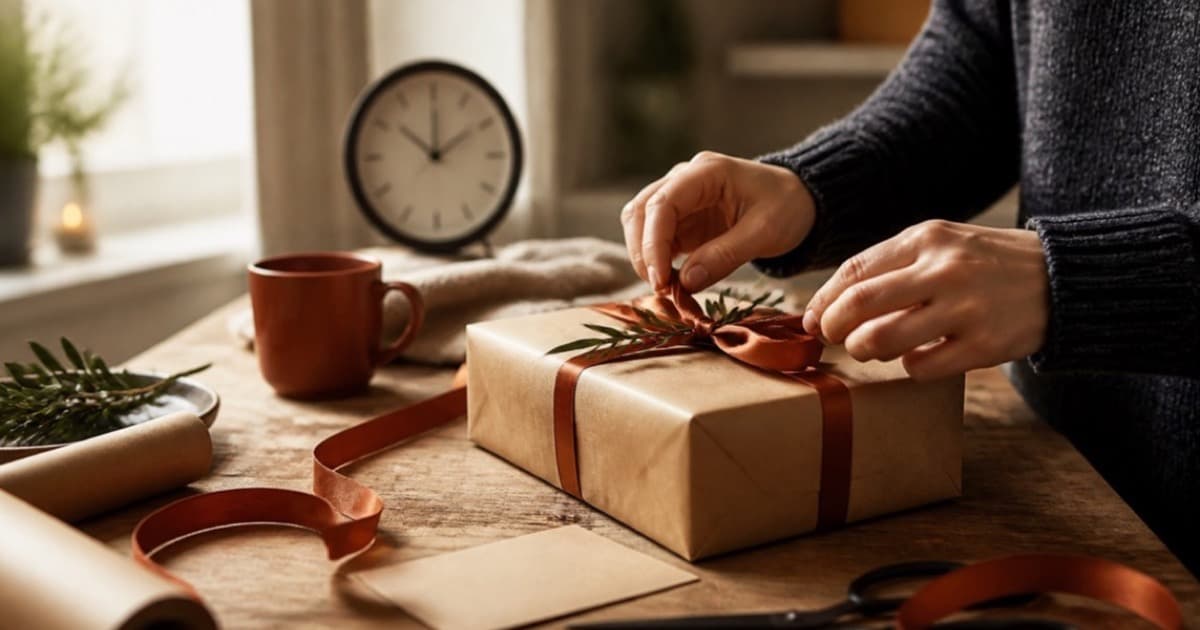
Brown paper, twine, and something small tucked under the string — a sprig of eucalyptus, a cinnamon stick, a leaf. Costs about two dollars and instantly looks deliberate.
If you have no paper: a tea towel, a scarf, or a cloth napkin works and becomes part of the gift. If you have nothing at all, a paper bag with the top folded over twice and a real ribbon still beats a plastic bag by a mile.
Never: hand something over in the shop's own bag with the receipt in it.
2. Write something specific (six minutes)
This is the whole trick, and it's free.
Generic: "Happy birthday! Hope you have a great day. Love, Tom."
Specific: "You made me try this chilli oil at your place in March and I've bought four jars since. I still think about that pasta. Happy birthday."
The second one is thirty seconds of extra effort and it changes the category of the gift entirely. It proves attention, which is the thing recipients are actually reading a gift for.
There's a useful piece of research behind this. Julian Givi and Jeff Galak found that givers shy away from sentimental gifts because they fear getting them wrong, even where recipients may have preferred them (Givi & Galak, 2017). A specific, slightly vulnerable note is the lowest-cost version of a sentimental gift available — and it takes six minutes.
Why consumables work so well under pressure
Three reasons worth understanding, because they generalise:
They can't be dated. Nobody can tell whether you bought excellent coffee three weeks ago or forty minutes ago.
Quality is immediately legible. A good bar of chocolate or a good bottle of oil visibly signals quality in a way that a mid-price object doesn't.
They don't create a storage problem. Ernest Baskin and colleagues found recipients weight feasibility — how easy something is to actually use — more heavily than givers do (Baskin et al., 2014). Consumables are maximally feasible. There's no decision to make.
The one rule: buy the best version of a small thing, not a mid-version of a big thing. Excellent coffee beats a mediocre hamper every time, and costs less.
What to avoid, even in a panic
- Petrol station and airport gifts. The one category everyone recognises on sight.
- Front-of-store gift sets. Universally identifiable.
- The biggest available box of chocolates. Volume is not quality.
- Anything requiring a size. You'll get it wrong and they'll have to tell you.
- Novelty and gag gifts. Funny for eight seconds, awkward afterwards.
- An unwrapped item handed over in the shop bag. Even a great gift dies here.
- Apologising for it. Whatever you've got, hand it over like you meant it.
If the recipient is someone who genuinely doesn't want objects, skip the shops entirely and read what "no gifts" actually means instead.
The 20-minute emergency protocol
If you have less than half an hour, do exactly this:
- Two minutes: write down one thing they've mentioned liking, complaining about, or wanting. One thing.
- Ten minutes: go to the best food shop or bookshop nearby and buy the highest-quality single thing connected to it.
- Four minutes: wrap it in brown paper with twine.
- Four minutes: write three specific sentences about why you chose it.
That's it. That's a genuinely good gift, delivered in twenty minutes, and it will outperform a lot of things that took people weeks.
Frequently asked questions
What is a good last-minute gift for someone?
Something consumable and excellent from a local shop — good coffee, good chocolate, great olive oil — wrapped properly with a specific note. Alternatively, a booked experience with a real date on it, which takes ten minutes online.
How do I make a last-minute gift look thoughtful?
Presentation and the card. Brown paper and twine takes four minutes; three specific sentences about why you chose it takes six. Those two things are what separate a rushed gift from a considered one.
What can I get today with no shopping at all?
A letter, a printed and framed photo, a playlist with notes, a cooked dinner on a named date, or a voucher for a specific task you'll take off their hands. These aren't fallbacks — several of them outperform bought gifts.
Are gift cards a bad last-minute gift?
Only if they're generic. A card for the specific coffee shop they go to every morning, sent with a note about what to order, reads as attentive. A generic mall card reads as a transaction.
Is it obvious when a gift is last-minute?
Usually only from the wrapping, the card, and whether you apologise for it. The object itself rarely gives it away — which is why fixing those three things is the whole strategy.
What if I have no money at all?
Give time, specifically and with a date. A cooked dinner, a day of help with something they've been avoiding, or a genuinely written letter. Give it properly, with a card, on the day.
How do I avoid this happening again?
Two calendar reminders per occasion — one three weeks out, one three days out. The three-week one is where all the value is. The full system takes half an hour to set up: gift planning system.
The takeaway
Time doesn't make a gift good. Attention does — and attention can be demonstrated in under twenty minutes if you know where to spend it.
Buy the best version of a small thing. Wrap it in brown paper. Write three sentences that could only have been written about that specific person.
Then hand it over without apologising, because as far as anyone can tell, you meant to do this all along.
Need something today? Describe them in a sentence and get 20 real gift ideas in about a minute — free, no sign-up, with live prices and delivery info so you can check what actually arrives in time.
Still stuck on the perfect present? The AI gift generator turns a one-sentence description into 20 personalized ideas in about a minute.