Choosing well
Is "Receiving Gifts" Really a Love Language? What the Research Actually Says

"My love language is gifts" is one of those sentences that has quietly taken over how people talk about relationships.
It's a useful shorthand. It's also, for a lot of people, a source of low-grade anxiety — because if your partner's love language is gifts and you're bad at buying them, that starts to feel like a fundamental incompatibility rather than a skill you haven't learned yet.
So it's worth being honest about something: is receiving gifts a love language in any scientifically meaningful sense? The evidence is a lot weaker than the framework's popularity suggests.
But — and this is the more interesting part — the instinct underneath it is basically right, and there's better research explaining why. Here's the honest version.
The short answer
The five love languages are a popular framework, not a validated scientific model. Research that has examined it has generally failed to support its core claims: that people have one primary love language, that these fall into exactly five categories, and that matching partners' languages predicts relationship satisfaction.
But the underlying observation is sound. People genuinely do differ in what makes them feel cared for, and for some people a well-chosen gift is unusually strong evidence of attention.
What matters isn't the category — it's the specificity. A gift "works" when it proves you noticed something. That's true regardless of what anyone's love language is.
Where the framework came from
The five love languages — words of affirmation, quality time, receiving gifts, acts of service, physical touch — were introduced in a 1992 book by Gary Chapman, a pastor and marriage counsellor. It was based on patterns he observed in counselling, not on empirical research.
That's not a criticism in itself. Plenty of useful ideas start as clinical observation. The problem is what happened next: the framework became enormously popular and was widely treated as established psychology, without the validation work being done first.
What the research has found when it looked:
Studies examining the framework have generally not supported the idea of a single primary love language — people tend to value multiple categories rather than one dominant one. Attempts to confirm that the five categories are distinct and exhaustive have had mixed results. And the central practical claim — that matching your partner's love language improves relationship satisfaction more than simply being generally expressive — hasn't found consistent support.
A useful way to think about it: the framework is better as a conversation starter than as a diagnosis. "I feel most appreciated when you do X" is genuinely valuable information. "My love language is gifts, therefore you must express love through objects" is a much stronger claim than the evidence supports.
What the actual gift research says
Here's where it gets useful. There's a substantial body of peer-reviewed research on gift-giving specifically, and it explains the "gifts person" phenomenon better than the love languages framework does.
Gifts signal attention, and attention is the actual currency
The thing a good gift proves is that you were paying attention. That's the mechanism.
This is why price is such a weak lever. Francis Flynn and Gabrielle Adams found that givers expected more expensive gifts to generate more appreciation, while recipients in their studies didn't report appreciation tracking price that way (Flynn & Adams, 2009).
If someone says gifts matter to them and you conclude you need to spend more, you've likely misread it. What they're usually describing is a desire for evidence of being known.
Gifts that reflect the giver build closeness
Lara Aknin and Lauren Human found a consistent preference for gifts reflecting the recipient's interests, but also that gifts reflecting the giver were associated with greater reported closeness in the contexts they studied (Aknin & Human, 2015).
This is more interesting than it first appears. A gift that shares something of yours — the book that changed your mind, the album you can't stop playing, the place you want to take them — creates connection in a way a purely recipient-focused gift doesn't. The distinction is between sharing and imposing.
Experiences can strengthen relationships more than objects
Cindy Chan and Cassie Mogilner found experiential gifts strengthened relationships more than material gifts in the situations they studied — and notably, the effect didn't require the giver to be present. It was linked to the emotion the recipient felt during the experience (Chan & Mogilner, 2017).
So if your partner "loves gifts," an experience may still be the better answer.
Sentimental gifts are systematically under-given
Julian Givi and Jeff Galak found that givers avoid sentimental gifts because they fear choosing wrong — even in cases where recipients would have preferred them (Givi & Galak, 2017).
For someone who reads gifts as evidence of care, this is the highest-value category and the one most people avoid. The obstacle is nerve, not budget.
Asking works better than surprising
Francesca Gino and Francis Flynn found recipients appreciated explicitly requested gifts more than givers expected (Gino & Flynn, 2011). Givers assume the surprise adds value. Recipients mostly want the thing.
What to do if your partner says gifts matter to them
Practical translation, based on the above.
1. Stop thinking about occasions. The most powerful version of this isn't the birthday gift. It's the unprompted $6 thing on a Tuesday because you saw it and thought of them. Frequency and unexpectedness communicate attention far more efficiently than one annual purchase.
2. Start capturing clues. Keep a running note of things they mention, complain about, or admire. This is the entire mechanism — you can't demonstrate attention without a record of what you noticed. The gift planning system covers the habit.
3. Prioritise specificity over price. "I remembered you said this" beats "this was expensive" by a distance. If your budget is tight, spend it on precision instead. See thoughtful gifts under $50.
4. Write the reason down. The note is where the attention becomes visible. Two specific sentences about why you chose it does more work than the object.
5. Include yourself in it. Share something of yours with a clear bridge to them. "This is the album I've been playing all year — track four made me think of that night in Lisbon."
6. Ask them. It doesn't cheapen it. It improves the hit rate, and the research is clear on this.
If gifts don't come naturally to you
Some people find gift-giving genuinely difficult, and framing that as a deficiency in how you love someone is neither accurate nor helpful.
It's a learnable skill, not a personality trait. The people who are good at it are mostly just capturing information systematically. You can do that.
The minimum viable version: one note in your phone. Write down anything they mention wanting, complaining about, or admiring. Check it before any occasion. That's genuinely 80% of it.
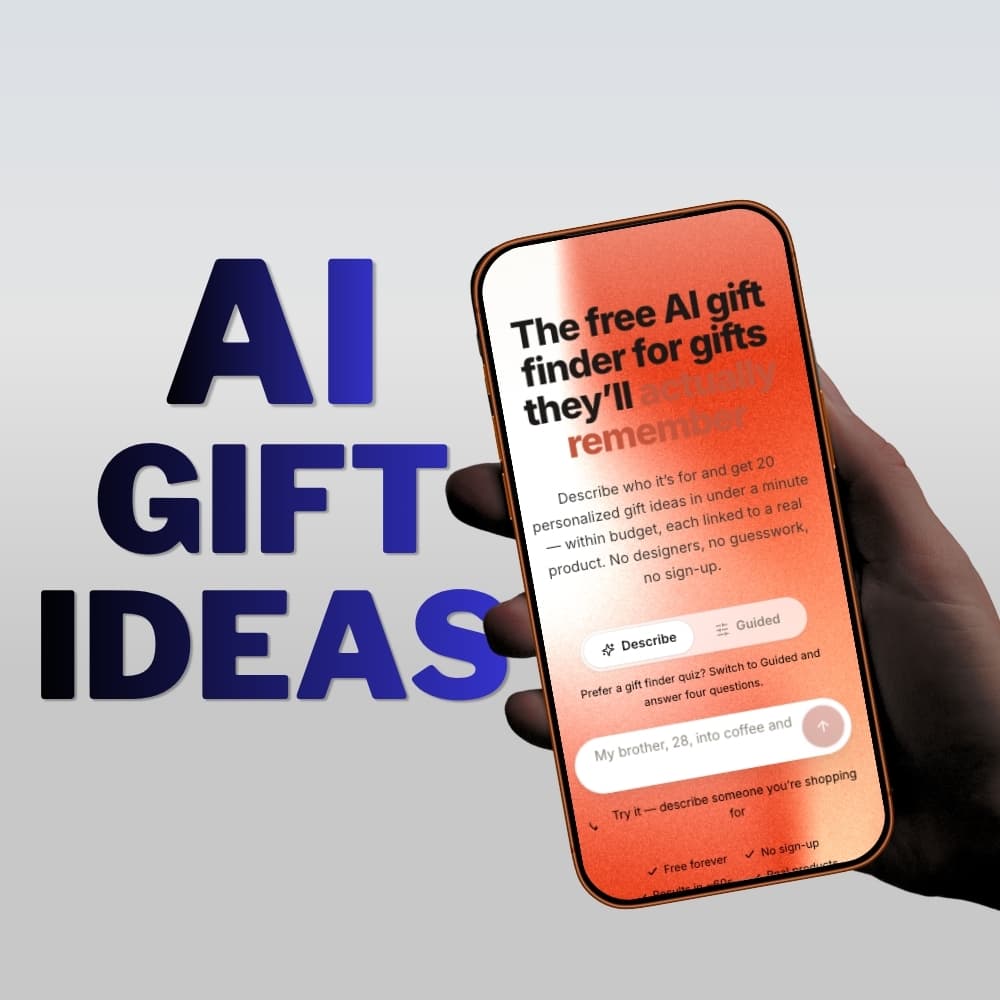
Use tools rather than relying on inspiration. Describe them properly — what they actually do each week, what they've said recently, what they already own — and the free AI gift finder will do the ideation. Your job is supplying the observations, which is the part only you can do.
Say it out loud. "I find this hard and I want to get better at it" is a much better conversation than an annual disappointment neither of you names.
The more useful question
Instead of "what's your love language," try these:
- "What's something small I could do that would make your week better?"
- "When have you felt most looked after by me?"
- "Is there anything you've been wanting but haven't got round to buying?"
These produce specific, actionable answers. "My love language is gifts" produces a category, and categories don't tell you what to do on a Tuesday in March.
Frequently asked questions
Is the five love languages theory scientifically valid?
It's a popular framework rather than a validated psychological model. Research examining it has generally not supported the core claims — a single primary language, exactly five distinct categories, or matching partners' languages predicting satisfaction. The broader observation that people differ in what makes them feel cared for is well supported.
What does it mean if someone's love language is receiving gifts?
Usually that they read a well-chosen gift as strong evidence of attention. The important variable is specificity, not price — they're responding to being noticed, not to being spent on.
Does that mean my partner is materialistic?
No, and the research doesn't support that reading. Gifts function as a signal of attention; the object is the medium rather than the message. The evidence that price drives appreciation is notably weak.
How do I get better at giving gifts if it doesn't come naturally?
Keep a running note of things they mention, complain about or admire, and check it before any occasion. Almost all skilled gift-giving is systematic capture rather than natural intuition.
Are experiences better than objects for a "gifts person"?
Often, yes. Research suggests experiential gifts can strengthen relationships more effectively than material ones. What matters is that the experience is specific to them and that you handle the logistics.
Should I ask my partner what they want?
Yes. Research consistently finds recipients appreciate requested gifts more than givers expect. You can ask for a category or a shortlist if you want to preserve some surprise. The birthday wishlist maker makes this less awkward.
What's better than one big gift?
Several small, well-observed ones spread across the year. Frequency and unexpectedness communicate attention more efficiently than a single annual purchase, and they're usually cheaper in total.
The takeaway
"My love language is gifts" is a shorthand built on a framework with less scientific support than its popularity implies. But people who say it are almost never asking for more expensive things.
They're asking to be noticed. And the noticing — not the spending — is the part you can actually get good at.
Keep a note. Write down what they say. Buy the small specific thing on a random Tuesday and tell them why.
That works whether or not the framework does.
Turn what you've noticed into an actual gift. Describe them in one honest paragraph — what they do, what they've mentioned, what they already own — and get 20 personalised ideas in about a minute, free and with no sign-up.
Still stuck on the perfect present? The AI gift generator turns a one-sentence description into 20 personalized ideas in about a minute.